
About
Advertisement
Uses
Varieties
✓ generally accepted · ✗ less commonly used
- Biggs Jasper— Jasper from Biggs Junction, Oregon, with varying light and dark color brown bands and pretty formations.
- Brecciated Jasper— Jasper in rounded fragments naturally cemented together in a gray material; appears similar to breccia.
- Bruneau Jasper— Jasper from Bruneau Canyon, in Owyhee County, Idaho, with distinctive brown, cream, (and sometimes even red or green) banding and patterns.
- Jaspilite— Banded rock that is a mixture of Hematite and Jasper.
- Morrisonite— Multicolored Jasper from the Owyhee River gorge in Malheur Co., Oregon.
- Ocean Jasper— Form of Orbicular Jasper found on the coast of Madagascar with small, tight, concentric ring formations.
- Orbicular Jasper— Jasper with rounded concentric rings throughout.
- Riband Jasper— Jasper with banded stripes, usually dark red, brown, yellow, or white bands.
- Agate Jasper— Opaque multicolored Jasper, or Jasper with banding; may also refer to a single stone with a combination of both Agate and Jasper.
- Cave Creek Jasper— Reddish Jasper found near Cave Creek in Maricopa County, Arizona.
- Deschutes Jasper— Jasper from a deposit slightly east of Biggs Junction, Oregon, near the Deschutes River, with good banding and interesting color formations.
- Egyptian Jasper— Form of Orbicular Jasper with white and gray circles on a red background. It is found as rounded pebbles on the beaches of Egypt. A similar Jasper is found on the beaches of Washington state and sometimes also labelled as Egyptian Jasper.
- Green Jasper— Jasper with a light to dark green color. Green Jasper differs from Prase and Plasma since it is fully opaque.
- Kinradite— Orbicular Jasper with concentric rings of colorless or white Quartz. Occasionally used as a synonym of Jasper.
- Leopard Jasper— Form of Orbicular Jasper with tan color rings, appearing similar to the spots of a leopard.
- Morgan Hill Jasper— Jasper from Morgan Hill, California, with small reddish and yellow "poppy" formations. Also synonymous with "Poppy Jasper".
- Moss Jasper— Form of Jasper or Chalcedony containing dense inclusions of
green Hornblende that cause the pattern to resemble moss. Often used
as a synonym for Moss Agate, though Moss Agate is translucent whereas Moss Jasper is opaque.
- Opal Jasper— Form of Brecciated Jasper in which the cementing material is Opal.
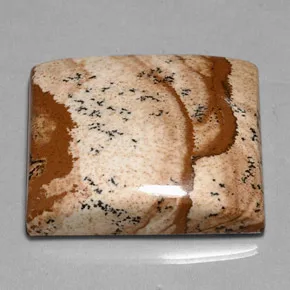
- Owyhee Jasper— Form of Jasper with scenic picture formations found near the Owyhee River in Oregon.
- Picture Jasper— Form of Jasper with scenic picture-like formations.
- Poppy Jasper— Form of yellow Orbicular Jasper with red concentric rings.
- Ribbon Jasper— Form of Banded Jasper with think banded lines.
- Rogueite— Green form of Jasper from the Rogue River in Oregon.
- Russian Jasper— Jasper from Russia, usually with reddish spots.
- Stone Canyon Jasper— Yellowish Brecciated Jasper from Stone Canyon (near San Miguel), California.
- Wascoite— Jasper from Wasco Co., Oregon, with irregular yellow, pink, and red concentric bands.
- Zebra Jasper— Dark brown Jasper with lighter brown to white colored banding streaks.