
About
Deposits where Agates are commercially mined are usually very extensive, thereby enabling this gemstone to be affordable and inexpensive. However, a fine and sharp banded pattern, combined with natural strong coloring, will quickly increase the cost and value of and Agate. Specific Agate localities will provide similarities in banding style and color, thereby lending many Agates a geographic prefix. Other variety names used will connote specific colors or patterns, such as Fire Agate or Eye Agate.
The history of Agate production is closely tied to German town of Idar-Oberstein, which has evolved as an important gemstone center. Agates and Jasper were historically found in the Idar-Oberstein region, and cut and polished by local craftsman. With the discovery of the enormous Agate deposits in Rio Grande do Sul, Brazil in the 1800's, the new material was shipped to Idar-Oberstein for cutting and polishing. The local Agate cutters of Idar-Oberstein were well-suited for this job, having been historically trained in this profession. Idar-Oberstain remains today as an important cutting and polishing center.
Advertisement
Uses
Varieties
✓ generally accepted · ✗ less commonly used
- Onyx— Type of Chalcedony gemstone whose meaning can have several connotations. Its most practical gemstone definition describes a solid black Chalcedony, or a banded or layered black and white Chalcedony.
- Agate Geode— Layer of Agate surrounding a cavity in a geode that is
usually lined with a layer of small Quartz crystals.
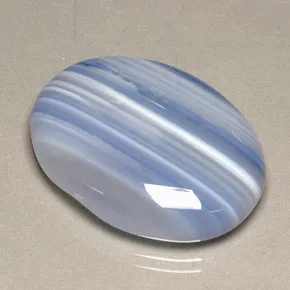
- Blue Lace Agate— Agate with light blue bands in a lacy or wavy pattern.
- Botswana Agate— Agate from the African country of Botswana banded with fine parallel lines of white, purple, or peach.
- Condor Agate— Agate from San Rafael, Argentina, often with vivid colors.
- Crazy Lace Agate— Agate with twisting and turning bands of various colors.
- Dendritic Agate— Translucent Chalcedony with tree-like or fern-like inclusions.
Dendritic Agate is technically not a true Agate, as it lacks the
banding patterns exhibited in Agates.
- Eye Agate— Agate with banded, concentric rings that are perfectly rounded.
- Fire Agate— Form of Agate or Chalcedony that is
iridescent with a play of colors or "fire" similar to that of
Opal. Fire Agates usually have botryoidal growth included in their
interior. The play of color is caused by inclusions of Goethite or
Limonite.
- Fortification Agate— Agate with a pattern in which all bands connect to each other, causing it to resemble a medieval fortress (i.e. imaginary moat and walls surrounding the castle).
- Iris Agate— Rare iridescent Agate that exhibits spectral colors on a translucent colorless or white base.
- Laguna Agate— Well known form of colorful Agate with very dense banding from Ojo Laguna, Chihuahua, Mexico.
- Moss Agate— Chalcedony containing dense inclusions of green Hornblende that cause the pattern to resemble moss. Moss Agate is technically not a true Agate as it lacks the banding patterns of Agate.
- Sagenite Agate— Agate with acicular or or pointed inclusions of various minerals. These hair like formations are often arranged in fans or bursts.
- Sardonyx— Form of Agate with parallel bands of brownish to red alternating with white or sometimes black bands.
- Snakeskin Agate— Agate with a scale-like layer that resembles the skin of a snake. Also refers to a reddish brown Agate with small black concentric bands.