
About
Many precious Opals, besides being classified as either black or white Opals, are further classified based on the distribution and habit of their play of color. Some of these names have older sources, while some are recently coined trade names.
Opal doublets, often used in jewelry, are thin slices of precious opal glued onto a base material. Such gems are considerably cheaper than solid opals, yet provide the same play of color. Opal doublets are sometimes coated with a thin layer or dome of clear Quartz to make them more resistant to scratches (since Opal is a relatively soft gem). These are sometimes called Opal triplets.
A condition called crazing affects certain Opals, causing them to form internal cracks. Crazing is an interesting phenomenon, as it lacks consistency and is sometimes unpredictable. Although it can occur at random, its often takes place when an Opal removed from damp conditions is allowed to dry too quickly, or when an Opal is exposed to sudden intense light. Crazing may also take place when an Opal is subject to vibration, as during the cutting and polishing of a gemstone. The severity of the crazing and the time it takes to "craze" varies among gemstone. The origin is often a determining factor to its resistance to crazing, as some localities are less prone to crazing than others. A gradual drying process over months or even years can in some cases effectively stabilize the stone and allow it to be cut and polished with a substantially reduced risk of crazing.
Advertisement
Uses
Varieties
✓ generally accepted · ✗ less commonly used
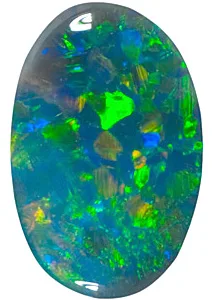
- Black Opal— Precious Opal with a black, dark blue, dark green, dark gray or similar darkly colored background or base color. Black Opal is the most valuable form of Opal.
- Boulder Opal— Precious Opal from Queensland, Australia, found in the cracks of, or as coatings on, ironstone or sandstone boulders.
- Common Opal— Any Opal without play of color.
- Hyalite— Colorless, light yellow, or blue transparent variety of Opal, lacking play of color.
- Mexican Fire Opal— Form of transparent Opal from Mexico, usually with an orange or red colors. Mexican Fire Opal usually refers to the form without play of color. If it exhibits a play of color, it is known as Precious Fire Opal.
- Precious Opal— Any Opal with a play of color.
- Andamooka Opal— Opal from Andamooka, South Australia.
- Banded Opal— Form of Opal with color bands.
- Cherry Opal— Orange-red to bright red variety of Mexican Fire Opal.
- Chrysopal— Opal similar to Prase Opal, but with a golden-green color.
- Claro Opal— Transparent Opal from Mexico with an intense red, green, blue, and yellow play of color.
- Contra Luz Opal— Opal where the play of color is visible only when a light source is behind the stone.
- Fire Opal— Yellow-orange to red Opal.
- Flash Opal— Opal with large schillers that abruptly appear and disappear as the stone is rotated.
- Gilson Opal— Synthetically produced Opal created using the Gilson process.
- Harlequin Opal— Opal in which the play of color is arranged in a consistent harlequin, diamond-shaped, or rectangular-shaped pattern that is very vivid. Harlequin Opal is one of the rarest and most prized forms of Opal.
- Honey Opal— Transparent to translucent Opal with an orange to orange-brown, honey-colored background. It may or may not display play of color.
- Hungarian Opal— Describes Opal from the old sources in Hungary (as well as other places in Europe such as the Czech Republic). This term has become corrupted and is sometimes used to describe White Opal from other locations as well.
- Jelly Opal— A transparent Precious Opal with a gelatinous appearance and a bluish sheen. Jelly Opal may also refer to a colorless, transparent Common Opal.
- Lemon Opal— Opal with a lemon-yellow color.
- Lightning Ridge Opal— Opal from Lightning Ridge (New South Wales), Australia. Although different forms of Opal are found at Lightning Ridge, this term often represents the high quality Black Opal found there.
- Moss Opal— Opal containing inclusions resembling moss.
- Nevada Opal— Opal from the Virgin Valley (Humboldt Co.), Nevada.
- Onyx Opal— Opal resembling banded Onyx.
- Opal Jasper— Form of Brecciated Jasper in which the cementing material is Opal.
- Opal Matrix— Thin layer of Opal on host rock (matrix).
- Pinfire Opal— Opal with very small, pinhead-size color flashes.
- Precious Fire Opal— Yellow-orange to red Opal (Fire Opal) with play of color.
- Slocum Stone— A synthetically grown Opal. Also called Slocum Opal.
- Virgin Valley Opal— Opal from the Virgin Valley (Humboldt Co.), Nevada.
- Wax Opal— Yellow to brown Opal with a waxy luster.
- White Cliffs Opal— Opal from the White Cliffs, New South Wales, Australia.
- White Opal— Precious Opal with a light colored body color, such as white, yellow, and beige. (Differentiated from Black Opal which has a dark background color.
- Yowah Nut— Small, rounded form of Opal from Yowah (Queensland), Australia in a nodule embedded in ironstone. Closely related to Boulder Opal, it occurs most often as walnut-sized ironstone nodules containing pockets, veins, or sprinklings of vivid Precious Opal.