
About
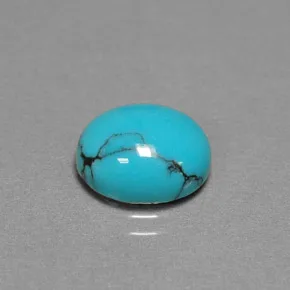
Turquoise can come in different shades of blue or green, and is commonly veined or mottled with brown or black oxides or a sandstone base. Some prefer this color veining, while others prefer a solid-colored stone. The best color in Turquoise is a solid, deep turquoise-blue hue. Greenish colors are less desirable and are not usually used as gemstones. Turquoise may occasionally also be mixed together with green Malachite or Chrysocolla, causing blue and green mottled gemstones.
Turquoise is a porous gemstone and is thus easily dyed. The dying is done to enhance the blue from more greenish or mottled stones. Dyed stones can eventually wear off their enhanced colors over the years, or when exposed to certain chemicals or solutions. The luster of Turquoise is often dull, and it is therefore very common for certain dealers to impregnate or coat the Turquoise with a a plastic lubricant or wax to enhance its luster. Due to the common practice of dying and enhancing Turquoise, this gemstone especially should only be purchased from reputable dealers who fully disclose all information.
The porous nature of Turquoise makes it more easily affected by oils and cleaners. Because of this, Turquoise gemstones should not be washed with anything other than water. Turquoise is also a relatively soft gemstone, and extra care should be exercised to prevent it from scratching.
Advertisement
Uses
Varieties
✓ generally accepted · ✗ less commonly used
- Eilat Stone— Greenish-blue mixture of Chrysocolla, Turquoise and other copper minerals such as Malachite from the copper mines near Eilat, Israel.
- Kingman Turquoise— Turquoise from the Mineral Park Mine near Kingman, Arizona, known for its good color.
- Navajo Turquoise— Turquoise from the American Southwest, especially Arizona, that contains black or brown patterns or spots throughout.
- Persian Turquoise— High quality Turquoise from the ancient deposits of Iran, especially at Nishapur. More commonly refers to pure Turqoise without any black or brown veins or embedded matrix.