
About
The value of Tourmaline has a very large range. The more common forms can be fairly inexpensive, but the rarer and more exotic colors can command very high prices.
The most expensive and valuable form of Tourmaline is the rare neon-blue form known by the trade name Paraiba Tourmaline. Paraiba Tourmaline was first discovered in a gem pegmatite in the Brazilian state of Paraiba in 1989. This new Tourmaline became extremely popular in a very short time, and the cost for this rare Tourmaline became astronomically high due to short supply. Small deposits of Tourmaline of similar color to Paraiba Tourmaline were also recently found in Nigeria and Mozambique, and these are often also called "Paraiba Tourmaline" in the gem trade. Other valuable forms of Tourmaline are Chrome Tourmaline, an intense-green Tourmaline found in Tanzania, Rubellite, the pink to red variety, and Indicolite, the rare blue variety.
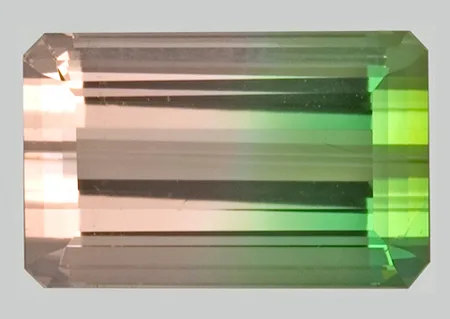
Multicolored stones are truly a gemological wonder, as their beauty and uniqueness are unparalleled. An interesting form of multicolored tourmaline, adequately called Watermelon Tourmaline, has a red center surrounded by a green outer layer (or vice versa). When used as a gem, Watermelon Tourmaline is green on one side and red on the other. Schorl, a common black Tourmaline, is fairly inexpensive.
All colored Tourmaline gems display pleochroism, meaning their color changes when viewed at different angles. In some Tourmaline gems, this effect is hardly noticeable, while in others it is strongly apparent. Gemstone cutters must take this into account when cutting a Tourmaline, so that the finished gem brings out its best color.
As mentioned above, virtually all Tourmaline gemstones are of the Elbaite type. Schorl, Dravite, and Liddicoatite are occasionally used as gemstones. Schorl, known as "Black Tourmaline" makes a dark, opaque, yet shiny black gemstone. Dravite is almost always brownish in color, and usually opaque. However, transparent forms do occasionally occur, and these can be used as rare brown gemstones. Dark brown Dravite may be heat-treated to lighten its dark color. Liddicoatite occurs in a great variety of colors and in excellent multicolored forms, but is too rare to be used extensively as a gemstone.
Advertisement
Uses
Varieties
✓ generally accepted · ✗ less commonly used
- Achroite— Colorless variety of Tourmaline.
- Canary Tourmaline— Bright yellow Tourmaline from a recent deposit in Malawi.
- Cat's Eye Tourmaline— Tourmaline displaying a cat's eye effect.
- Chrome Tourmaline— Tourmaline with a deep green color caused by chromium impuritiess.
- Dravite— Brown variety of Tourmaline. See the mineral Dravite for additional information.
- Elbaite— Individual member mineral of the Tourmaline group, and the Tourmaline form responsible for almost all Tourmaline gemstones. In the gem industry, the term Elbaite often connotes the green form, and occasionally the multicolored form. See the mineral Elbaite for additional information.
- Indicolite— Light to dark blue variety of Tourmaline.
- Paraiba Tourmaline— Neon blue, highly desirable variety of Tourmaline that originated in
Paraiba, Brazil. Its interesting color is caused by inclusions of
copper. Although technically the term describes only those Tourmalines from Paraiba in Brazil, the gem trade now uses it to describe any light to neon blue Tourmaline from any worldwide location.
- Rubellite— Pink to red variety of Tourmaline.
- Schorl— Black form of Tourmaline. See the mineral Schorl for additional information.
- Siberite— Occasionally used to describe purple Tourmaline.
- Verdelite— Occasionally used to describe green Tourmaline.
- Watermelon Tourmaline— Multicolored Tourmaline with a red center, surrounded by a green outer layer (or vice versa). Watermelon gemstones are multicolored red and green.
Treatments & Enhancements
Sources
Similar Gemstones
Green Tourmaline - Emerald, Peridot, Demantoid, and Tsavorite.
Red Tourmaline - Ruby, Spinel, Garnet.
Pink Tourmaline - Kunzite, Spinel, Pink Topaz, Morganite, Pink Sapphire.
Blue Tourmaline - Aquamarine, Blue Topaz, Sapphire, Zircon.