
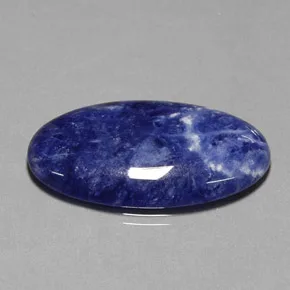
Deep Blue Sodalite
ISOMETRIC

Sodalite

Na8Al6Si6O24Cl2

Hardness
5.5–6
Refractive Index
1.48
Spec. Gravity
2.2–2.3
System
Isometric
View Mineral
Sodalite is a blue gemstone almost invariably veined with white streaks or markings. Its ideal color is an intense blue, and it comes in all shades of blue from light blue to deep royal-blue, and from grayish-blue to violet. Different shades of blue will often be present in a single gemstone. Sodalite is an opaque gemstone, though it is slightly translucent on thin edges.

About

Sodalite is not a prevalent gemstone, and suitable material only comes from a handful of localities. Despite this, Sodalite is a fairly inexpensive and obtainable. It is very similar to the more popular Lapis Lazuli, and may be used as a substitute for that more valuable gemstone.

Sodalite can be strongly fluorescent, often fluorescing bright orange to red, or cream. It may also be tenebrescent, in that its color will deepen upon exposure to ultraviolet light. This is especially true of the purple variety Hackmanite.

Uses

Sodalite is a minor gemstone and usually faceted into beads for necklaces and bracelets, with individual beads usually large in size. Tumbled rough Sodalite is also strung and used in jewelry. Sodalite is also used for ornamental carvings such as animal carvings and small statues.

Varieties

common  ·  uncommon

  • Hackmanite— Purple, sulfur-rich variety of Sodalite, usually with a pink or purple color. Hackmanite is an uncommon gemstone and is known for its tenberescent ability.

Treatments & Enhancements

Sodalite is natural and not treated or enhanced.

Sources

The primary workable Sodalite deposits are in Afghanistan, Australia, Brazil, and Canada (Ontario and British Columbia).

Similar Gemstones

Lapis Lazuli can appear similar to Sodalite with its intensely blue color, though it is usually associated with sparkling Pyrite which Sodalite lacks.

Further Reading

Faceted

In the Rough