
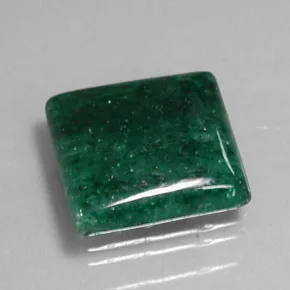
Emerald-Green Aventurine
HEXAGONAL

Aventurine

SiO2

Hardness
6.5–7
Refractive Index
1.54–1.55
Spec. Gravity
2.63–2.65
System
Hexagonal
Aventurine is a compact variety of Quartz / Chalcedony containing small included flakes or scales that give it a glistening effect. The inclusions are usually Muscovite mica, but may also be Hematite or Goethite. Though the color of Aventurine is most often associated with green, it can also be other colors such as gray, orange, and brown. However, color types other than green are uncommon, and rarely used as gemstones or ornamental material.

About

Aventurine gemstones can range from a light to dark green color. The green coloring agent of green Aventurine is Fuschite, which is a chromium-rich variety of Mucovite. The Fuschite is usually finely included within the Quartz, sometimes very heavily. For this reason, Aventurine is sometimes classified as a rock since it is technically a combination of two minerals However, most experts still treat Aventurine as a variety of Quartz, as the Fuschite is more likely an inclusions rather than a mineral combination.

The shimmering or glistening effect exhibited on Aventurine is known as aventurescence. This effect can be weak or more intense, depending on the size and density of the inclusions. The color of Aventurine can also vary based on the inclusions, and a single gemstone may have lighter and darker color zones. Most Aventurine has a grainy or sugary texture in a natural state, though this is usually removed when polished into a gemstone.

Uses

Aventurine is used as a minor stone for jewelry, as cabochons or beads mostly for necklaces and bracelets. It is also used as an ornamental stone for carvings and bookends, and is a popular aquarium stone.

False Names

Treatments & Enhancements

Aventurine gemstones are generally natural and not enhanced or treated.

Sources

Aventurine sources include India, Brazil, Austria, Russia and Tanzania.

Similar Gemstones

Aventurine may appear similar to Malachite and Variscite gemstones, but these are much softer and lack the aventurescence effect. Jade may be similar and lacks the aventurescence, as does Chrysoprase which is also usually lighter in color.

Further Reading

Faceted

In the Rough