
Alexandrite
ORTHORHOMBIC

Alexandrite

BeAl2O4

Hardness
8.5
Refractive Index
1.744–1.755
Spec. Gravity
3.5–3.8
System
Orthorhombic
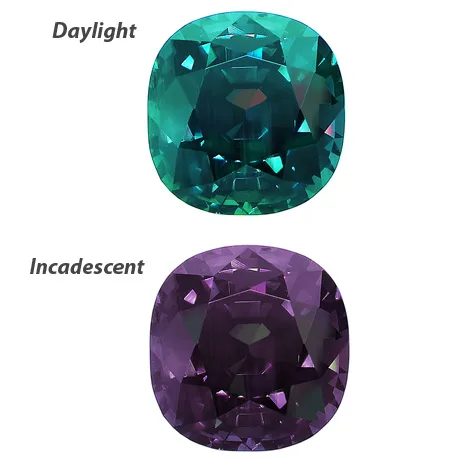
Alexandrite is the highly regarded color changing variety of Chrysoberyl. The color of Alexandrite changes under different lighting conditions. If viewed in daylight, its color is greenish blue to dark yellow-green. If viewed in incandescent or candle light, its color is pink to red. Alexandrite is a very rare and highly valuable gemstone, and until recently was extremely difficult to obtain due to its rarity. However, new sources in Brazil and Tanzania have made this gemstone available and more mainstream on the gemstone market.

About

Alexandrite was first discovered in Russia in the early 1800's. It was named in honor of Alexandar Nicholavich, who was later to become the Russian Czar Alexander II. Legend has it that the gemstone was discovered on the future Czar's birthday and named in his honor, though the factual nature of this is disputed.

The unique color change habit of Alexandrite is caused by slight impurities of the element chromium. The most desirable colors of Alexandrite are those that show a clearly visible pure hue color change, such as a pure green/blue in daylight to a pure red in incandescent light.

In addition to its color-changing habit, Alexandrite is a pleochroic gem, showing different color intensity when viewed at different angles. This factor must be taken into account when cutting Alexandrite gemstones. Alexandrite exhibiting chatoyancy does exist but is very rare, thus Alexandrite Cat's eye is rarely available.

Uses

Alexandrite is a rare and exquisite gemstone with outstanding color changing properties, and is most often faceted into round and cushion cuts that can bring out the best in its color. In jewelry, Alexandrite is used as rings and pendant centerpieces. Alexandrite in large sizes is extremely rare and valuable; most Alexandrite available is 2 carats or less.

False Names

Treatments & Enhancements

Alexandrite gemstones are not treated or enhanced. A synthetic form of Alexandrite exists, and it can be difficult to distinguish natural and synthetic Alexandrite from each other. Most synthetic Alexandrite is in fact synthetic Corundum or synthetic Spinel with added vanadium or chromium to induce the color-change habit.

Sources

Alexandrite was originally discovered in the Sanarka River in the southern Ural Mountains of Russia. However, the Russian deposits have long since been exhausted, and Russian sources of Alexandrite are near impossible to obtain. Small deposits were subsequently found in Sri Lanka (Ceylon), and until the 1980's these were the only two sources of this rare gemstone. Since then, new deposits have been discovered in Brazil, Tanzania, and Madagascar, with the Brazilian sources being the most significant.

Similar Gemstones

Further Reading

In the Rough