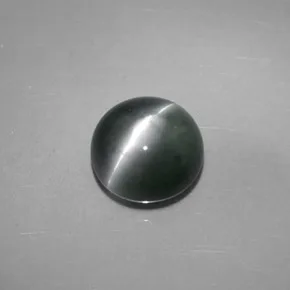
Cat's Eye describes a gemstone polished into a cabochon that displays a narrow band of concentrated light going accross the width of the stone. This effect, known as chatoyancy, or cat's eye effect, is caused by inclusions of fine,
slender parallel mineral fibers in the gemstone that reflect light in a single band. Of all the gemstones that exhibit cat's eye, Chrysoberyl Cat's Eye is the best known. Chrysoberyl has the strongest and most distinct cat's eye effect of all gemstones. Though several different gemstones types exhibit a cat's eye effect, only Chrysoberyl's cat's eye enjoys the
privilege of having the name "Cat's Eye" without any prefix. Whenever the term "Cat's Eye" is used, it refers to Chrysoberyl cat's eye by default, unless otherwise specified.
About
The intensity of Cat's Eye can vary from strong to weak. The clarity and intensity of the cat's eye band will play an important role in the value of a Cat's Eye gemstone. A bright and straight light effect is the most desired, and when strong and perfect it will be highly valued. In some forms of Chrysoberyl, the cat's eye effect is weak, appearing only as a
billowy, floating light reflection as opposed to a bright, concentrated
band of light. Such Chrysoberyl is known as Cymophane, and the effect is
called cymophane effect.
Advertisement
Uses
Cat's Eye is polished into cabochons, and is used most often in rings and pendants.
False Names
All non-Chrysoberyl Cat's Eye gemstones are associated together with their gemstone name. However, some unscrupulous dealers may label less expensive forms of Cat's Eye simply as Cat's Eye without specifying the gemstone type, and one should always be aware of this.
Treatments & Enhancements
Chrysoberyl Cat's Eye is not treated or enhanced.
Sources
Cat's Eye sources are in Brazil, India, China, and Zimbabwe.