
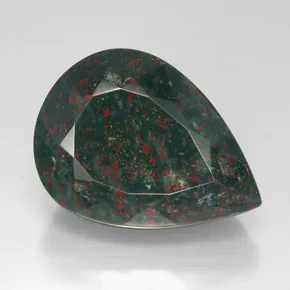
Heavily Mottled Bloodstone
HEXAGONAL

Bloodstone

SiO2

Hardness
7
Refractive Index
1.54–1.55
Spec. Gravity
2.63–2.65
System
Hexagonal
Bloodstone is a dark green to dark bluish-green variety of Chalcedony that is speckled with red or brown spots. The spotting appears similar to blood stains, as is indicative of the name of this gemstone. The spots may be very sparse to almost non-existent, or they may be very dense and interwoven. Bloodstone may also have red markings as stripes or veins, though spotting is the most prevalent and desirable habit.

About

Bloodstone is an ancient gemstone, and was historically regarded for its metaphysical aspects. Even today, many people find many metaphysical significance towards this gemstone because of its unique appearance and name. Although the modern-day birthstone for March is Aquamarine, Bloodstone is regarded as the traditional birthstone for March.

The red or brown spots in Bloodstone are formed by iron oxide impurities, especially Hematite. The solid green color is caused by dense inclusions of Chlorite or amphibole minerals inside the Chalcedony. The base color of Bloodstone may be solid green, but it often has an uneven color distribution, with lighter and darker green zones, or even bluish-gray or dark yellow streaks and spots.

Uses

Bloodstone is most often cut into cabochons and beads, where it is used in bracelets and necklaces, and sometimes rings. It is only occasionally cut into other gemstone facets. Bloodstone has been traditionally used as a seal stone, and is sometimes carved into small carvings and figures.

Treatments & Enhancements

Bloodstone is usually naturally colored and not enhanced.

Sources

Bloodstone sources include India, Madagascar, Brazil, China, Australia, and Germany.

Similar Gemstones

The unique color habit of Bloodstone can distinguish it from all gemstones.

Further Reading

In the Rough